
There is an interesting contrast emerging across the global and Indian AI ecosystem.
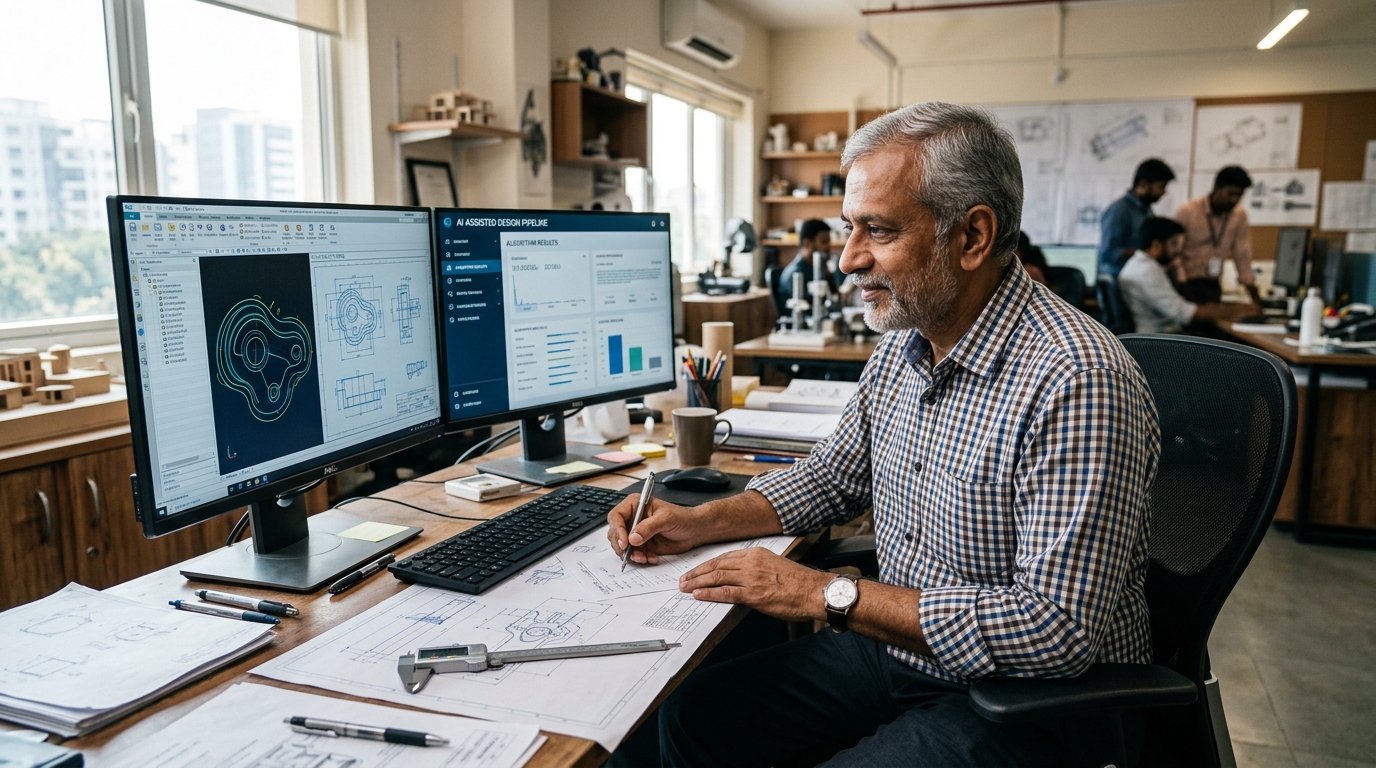
Recently, we were approached by a large engineering organisation with a very specific, high-friction operational challenge. They wanted to explore whether AI could assist their product design teams in a complex, multi-stage engineering workflow.
Around the same time, I happened to read a high-profile round-table discussion in a reputed publication where senior leaders from several leading enterprises spoke about their AI initiatives. Almost everyone had an impressive AI story to tell—Generative AI, conversational copilots, automated content creation, customer engagement bots, personal productivity enhancements, and exploratory pilots with the latest foundation models.
It made impressive reading.
But it also made me think.
“Are we sometimes confusing the visibility of AI with the depth of AI adoption?”
Today, there are organisations that are remarkably vocal about AI. Every preliminary experiment becomes an internal newsletter, a viral LinkedIn post, a conference keynote, or a press release.
And then there are organisations quietly trying to change how real work gets done.
They are not asking: “How do we showcase AI?”
They are asking: “Can AI help us redesign this core workflow?”
That is a fundamentally different conversation.
The Difficult AI Problems Are Often Hidden Inside Workflows
The engineering challenge we encountered is an instructive case in point.
At first glance, the requirement sounds deceptively straightforward:
“Take a 2D engineering drawing as an input, and assist the designer in producing the required product design.”
Anyone who has spent time around mechanical engineering, discrete manufacturing, or EPC capital equipment knows what lies behind that seemingly simple statement.
An engineering drawing is not merely a picture or a PDF page. It is a dense, high-dimensional contract of geometry, projections, contours, dimensional tolerances (GD&T), surface finishes, annotations, material standards, and embedded engineering intent.
Before a software system can assist an experienced designer, that embedded intelligence must be extracted with zero tolerance for guesswork:
- Contour & Geometry Interpretation: The system must distinguish visible outlines from hidden lines, centerlines, section cuts, and projection views across multiple orthogonal planes.
- Dimensional & Annotation Binding: It must associate dimensional callouts, datum references, and bilateral tolerances with their exact corresponding topological features.
- Specification Construction: Product parameters must be systematically compiled to reflect functional requirements, operating pressures, temperatures, and structural envelopes.
- Constraint & Rule Application: Standard engineering codes (ASME, ISO, DIN), proprietary corporate design rules, and customer-specific constraints must be rigorously evaluated.
- Downstream Design & Cost Translation: The validated configuration must translate into final CAD models, manufacturing bills of material (BOM), tooling setups, and accurate production costing.
When teams attempt to tackle such challenges with naive AI approaches—such as feeding drawing images directly into a generic multimodal LLM—the effort rapidly disintegrates. The model hallucinates dimensions, confuses projection datums, and fabricates costing numbers.
We recognized that success required decomposing the challenge into an end-to-end, multi-technology pipeline rather than treating it as a single monolithic AI problem.
The 6-Stage Hybrid Engineering Pipeline
The resulting architecture spans roughly five to six interconnected stages, each engineered with the specific computational tool best suited for that mathematical domain:
6-Stage AI-Assisted Engineering Pipeline
Human-in-the-Loop Validation at Every StageMultimodal Ingestion & OCR
Extracts title block metadata, revisions, material callouts, and tabular notes from raw scanned or digital 2D drawings.
Contour & Geometry Parsing
Reconstructs vector topological features, separates boundary contours from hatching, and identifies projection views.
Dimension & GD&T Association
Anchors dimensional callouts, tolerances, and surface roughness symbols to specific geometric boundaries and datum axes.
Engineering Rules & Constraints
Applies deterministic physics formulas, material grades, manufacturing envelopes, and international engineering standards.
Part Intelligence & Spec Matching
Classifies standard vs. custom components, matches historical catalog parts, and cross-references customer RFP specs.
Automated Costing & Design Export
Generates parametric 3D CAD drafts, manufacturing process routing, scrap calculations, and line-item cost estimates.
Notice the architectural diversity in this pipeline. Different stages require completely different technologies:
- Computer Vision handles document segmentation and raster-to-vector line parsing.
- Computational Geometry solves topological boundary representations and contour geometry.
- Deterministic Rule Engines enforce non-negotiable stress limits, ASME/ISO compliance, and manufacturing tolerances.
- Machine Learning recognizes patterns across historical part libraries to maximize component reuse.
- Language Models parse unstructured customer RFP tender documents and provide natural language synthesis.
That last distinction is critical:
“AI does not necessarily mean putting an LLM in the middle of everything.”
In engineering, precision is non-negotiable. Where physics and arithmetic govern the outcome, deterministic engines must rule. Where unstructured semantic interpretation is needed, language models provide immense leverage. True enterprise intelligence lies in orchestrating these complementary disciplines into a unified workflow.
The Real Opportunity: AI-Assisted Engineering
There is another persistent misconception that deserves direct examination.
Whenever artificial intelligence enters the domain of engineering design, the immediate question invariably asked is:
“Will AI replace the design engineer?”
I believe that is entirely the wrong question.
A far more constructive and realistic question is:
“How much of the designer's repetitive cognitive workload can we remove so that the engineer spends more time on actual engineering?”
Consider how much experienced engineering talent is consumed every day in routine, repetitive friction:
- Manually deciphering poorly scanned legacy customer drawings.
- Transcribing dimensional data and bill of materials into ERP and PLM systems.
- Cross-referencing previous job binders to locate similar past designs.
- Re-verifying standard tolerance tables and corporate design codes.
- Calculating machine cycle times, cutting speeds, and scrap allowances for sales quotes.
Extensive studies by engineering research firms such as Tech-Clarity and the Aberdeen Group show that design engineers spend 32% to 49% of their working hours on non-value-added administrative tasks. Less than half of their day is dedicated to core design, creative problem-solving, and engineering innovation.
These repetitive tasks require engineering knowledge to execute, but they do not require the creative genius of your best engineers.
Human-in-the-Loop: Speed Without Sacrificing Rigor
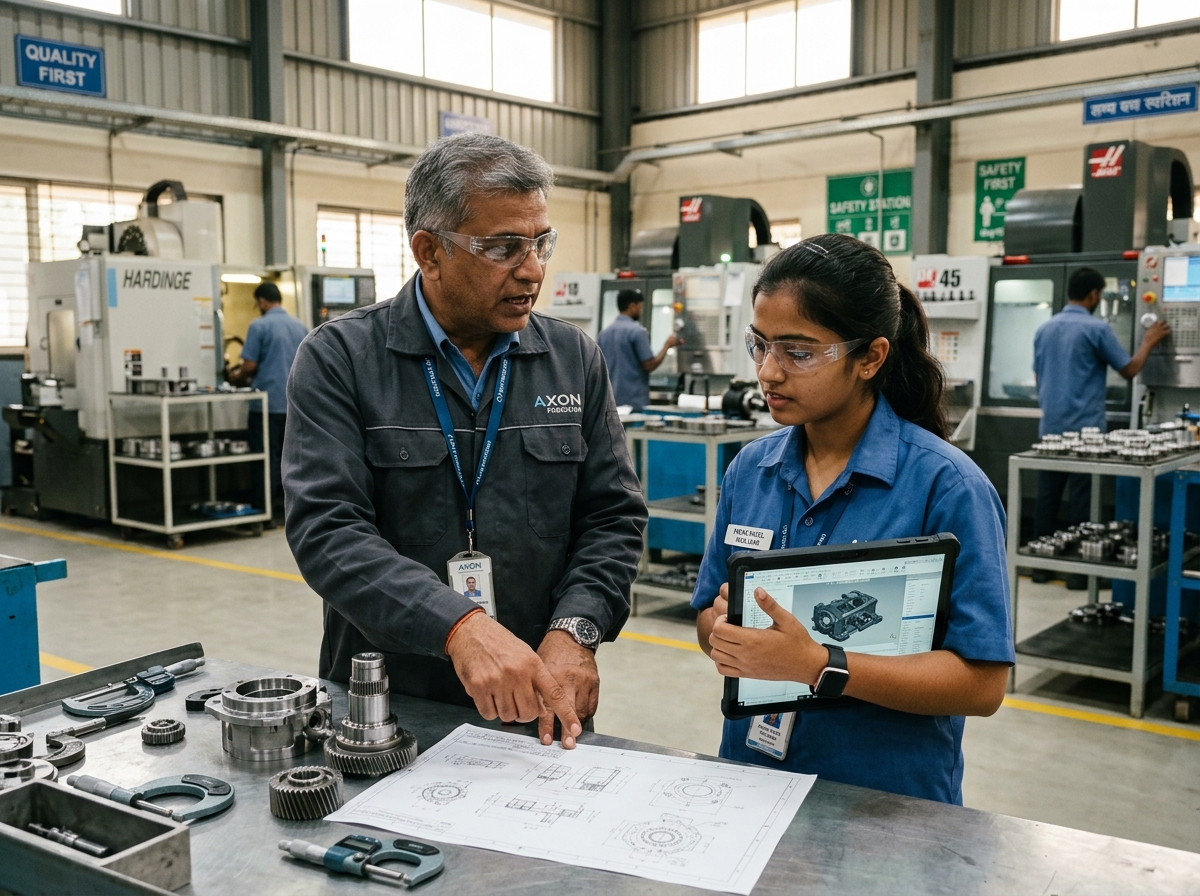
An AI-assisted workflow offloads the tedious mechanical transcription, letting the engineer focus entirely on verification, optimization, and edge-case handling:
- AI performs the cognitive heavy lifting: extracting dimensions, parsing geometry, and staging the preliminary specification.
- The engineer remains in total control: reviewing parameters, adjusting tolerances, and approving the final model.
- We are not removing the engineer from the loop: we are compressing the loop from three days to 45 minutes.
Speed Is Only the First Benefit: The Strategic Agility Multiplier
It would be easy to justify an AI-assisted engineering pipeline purely on the basis of productivity.
If an engineering task that previously required 12 to 16 hours of manual drafting and estimation can now be completed in a fraction of that time, the internal cost economics are immediately compelling.
But the true strategic value lies elsewhere.
Indian engineering and manufacturing enterprises are operating in a market where customer expectations are shifting at unprecedented speed. Global and domestic buyers increasingly demand:
- High Customization: Standard catalog products are increasingly replaced by tailored, Engineer-to-Order (ETO) specifications.
- Rapid Quotation Turnarounds: Customers expect detailed technical bids and cost estimates within 24 to 48 hours rather than two to three weeks.
- Shorter Product Development Cycles: Delivery lead times have shrunk from quarters to weeks.
- Aggressive Cost Competitiveness: Margins must be protected through precise, audit-backed estimation rather than generic contingency markups.
Traditional engineering processes were designed for an era when product configurations changed slowly and customer RFQs arrived with generous response windows.
That world has vanished.
Consider what happens in an agile, AI-assisted enterprise today. A sales or proposal team receives a complex customer drawing in the morning. Instead of sending the request through a multi-department queue that takes days to interpret:
- The AI-assisted pipeline analyzes the drawing within minutes, extracting geometry and critical tolerances.
- The system maps requirements against internal manufacturing capabilities and flags potential manufacturability bottlenecks.
- A preliminary 3D CAD configuration is generated alongside a structured bill of materials.
- Parametric cost models calculate accurate material utilization, machining hours, and tooling costs.
- The lead engineer reviews, modifies, and signs off on the technical package.
Suddenly, AI is not merely saving a few engineering hours.
“AI is transforming the organization's responsiveness to the customer. That changes the commercial dynamic entirely.”
In discrete manufacturing and industrial EPC, being the first supplier to return an audited, technically validated quotation with accurate pricing dramatically lifts win rates. The technology shifts from an operational expense into a primary driver of top-line revenue growth.
Comparative Analysis: Headline AI vs. Operational AI
To understand where your organization sits on this trajectory, it helps to contrast superficial AI experimentation with governed operational transformation:
| Dimension | Headline AI (Superficial Visibility) | Operational AI (Workflow Depth) |
|---|---|---|
| Primary Strategic Focus |
Visibility • PR Showcasing pilots, issuing press releases, and distributing generic chat tools to employees. |
Workflow Redesign Deconstructing mission-critical bottlenecks in engineering, production, quoting, and supply chain. |
| Technology Stack |
Single LLM Prompt Treating complex industrial processes as a prompt-engineering problem for a commercial cloud LLM. |
Multi-Discipline Pipeline Orchestrating Computer Vision, Computational Geometry, Rule Engines, Part ML, and targeted LLMs. |
| Primary Success Metric |
Vanity Activity Metrics Number of AI tools procured, licenses assigned, or employee chat prompts logged per week. |
Economic Outcomes Cycle time reduction, RFQ quotation turnaround, first-pass design yield, and scrap reduction. |
| Human Relationship |
Replacement Rhetoric Framed around eliminating headcount or replacing specialized professionals with automated bots. |
Cognitive Ergonomics Removing repetitive data friction so senior engineers can spend 90% of their time on real engineering. |
| Commercial Value |
Marginal Personal Productivity Individual knowledge workers write emails 10% faster, but core enterprise throughput remains unchanged. |
Enterprise Market Agility Submitting verified custom engineering quotes in hours, capturing high-margin deals, and shortening deliveries. |
Redefining AI Maturity: 6 Diagnostic Questions for Leadership
This brings me back to the public conversation surrounding AI adoption.
There is nothing inherently wrong with experimenting with copilots, text generation, or foundation models. Organizations need room for technical exploration and digital curiosity.
But we must be disciplined about how we measure real AI maturity.
The number of AI tools deployed in your software stack is not a meaningful metric. Neither is the percentage of staff who possess a ChatGPT account.
A far more rigorous standard is to convene your operating leadership and ask six straightforward diagnostic questions:
Has Engineering Become Measurably Faster?
Can design, drafting, and specification cycles be executed in hours rather than days without sacrificing engineering rigor?
Has First-Pass Quality & Yield Improved?
Are geometric errors, tolerance stack-up conflicts, and rework caught before drawings reach the manufacturing floor?
Can Maintenance Problems Be Anticipated?
Does operational intelligence alert shop-floor managers to equipment wear and process drift before downtime occurs?
Can Custom Quotations Be Delivered in Hours?
Can your sales and estimating team return fully costed, technically validated RFQs to customers before competitors react?
Can Execution Risks Be Detected Early?
Can project managers identify material delays, subcontractor bottlenecks, and margin drift before they impact quarterly EBITDA?
Can You Adapt to Changing Specs Instantly?
When a client modifies operating parameters mid-stream, can downstream BOMs, tooling, and cost impact update automatically?
Those are harder problems than generating marketing copy or deploying an HR query assistant.
They are also precisely where AI starts creating serious, defensible economic value.
The Quiet Revolution: What Real Transformation Looks Like
Over the next few years, some of the most consequential AI transformations may never make the front page of the news.
They will unfold quietly inside design offices in Pune, precision tooling facilities in Coimbatore, heavy manufacturing complexes in Gujarat, and engineering project rooms in Bengaluru.
A customer drawing will arrive.
A multi-stage engineering workflow that previously required days of tedious, repetitive manual translation will execute seamlessly in minutes.
An experienced engineer will review the model, validate critical engineering parameters, make a few decisive judgment calls, and move on to solving the next complex challenge.
Nobody may call it revolutionary on social media.
But that is probably what real AI transformation will look like.
From 2D Engineering Drawings to Parametric CAD
Explore how Zero Zeta's AI-assisted workflow translates complex drawings into verified 3D CAD models, deterministic thermal calculations, and automated fabrication deliverables.

Transform Engineering Workflows into Strategic Competitive Advantage
Move beyond surface-level AI pilots and conversational wrappers. Explore how Zero Zeta designs governed, domain-specific AI pipelines for industrial and engineering enterprises.
Schedule an Engineering AI Consultation
Connect with Vineet Srivastava and Zero Zeta practice leaders to evaluate your engineering and operational workflows for high-impact AI pipeline integration.
Evaluate Your Enterprise AI Readiness
Complete our structured assessment to identify operational bottlenecks, data governance readiness, and high-impact industrial use cases.